1234math
These games may seem simple. And well... they are. Just like math is simple too. But don't be fooled. Underneath it all, 1234math is complex and sophisticated. As math is too.
These games teach math through experience and intuition rather than trial and error. Through flow and joy rather than force and frustration.
Each game has its own philosophy and approach, but they share one goal: to give students a deep, intuitive feeling for mathematics while learning the basics. And to remove the fear and feeling of inadequacy that unfortunately often exists when it comes to learning math.
Designed for daily practice
1234math is not designed to keep students on the screen but to get them off it – with something gained. Ten to twenty minutes of daily practice is my recommended dose.
The games have a low sensory load by design and are built to avoid flashy rewards and addictive loops. There is almost no text – no instructions to read and no menus to get through. Press a game and you are playing. The focused training is especially well-suited for neurodivergent learners who thrive with routine, calm environments and purposeful repetition.
Four games, one vision
Three games focus on the basic operations (plus and minus combined into one). The fourth, "1234", develops overview, hand-eye coordination and average calculations.
Each game starts the moment you press a key or touch the screen. Settings live behind the small gear in the corner.
± Plus & Minus
Controls: Arrow keys ←↑↓→ on a keyboard. On a touch screen, a joystick appears wherever you touch.
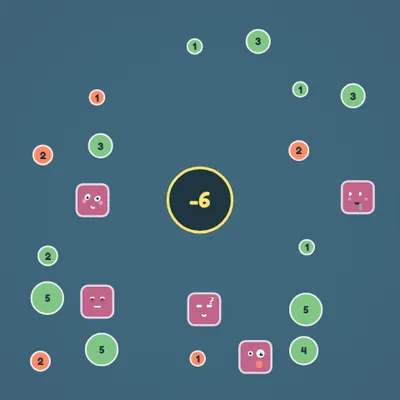
How it works: The player grows or shrinks as it collects dots – green dots add, coral dots subtract. A quick visual of each calculation appears on the player.
Monsters are off by default. Switch them on with the gear. Yes, there's a little Pac-Man DNA here, but these monsters can't be eaten. They change behaviour when the player enters "black hole state" – when the value drops below zero. Now you attract them, and their straight lines slowly bend toward you.
Seven levels await, with more dots per level. A new level begins the moment the last dot is collected. Keep your eyes open for extra lives in two of the levels.
Final challenge: For the top score of 500, stay alert. Late in the game you grow so large that corner dots become unreachable. Grab them early!
Pro-tip: Can the student reach a specific number the teacher suggests?
× Times Tables
Controls: ←→ to choose a lane, or tap a side of the road.
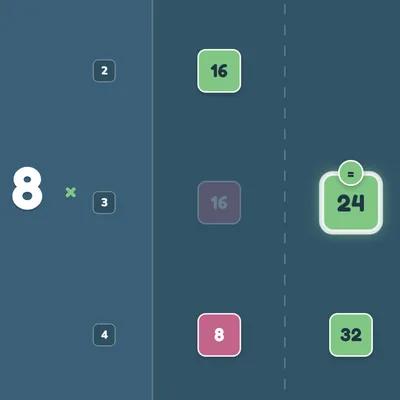
Pure multiplication tables. You drop onto the road and must choose left or right before the first answer arrives. Hesitate? The road waits until you decide. The ten small dots in the corner show how many tables are done.
Settings: colour help on or off (green is right, pink is wrong), a calm or a fast pace, and which tables to practise – from 1–10 up to 41–50. Higher tables take most students into unfamiliar territory.
Pro-tip: Have students say the answers out loud while they play.
/ Fractions
Controls: ↑↓ to move between the paths, or tap above or below the middle line.
Philosophy: This is where 1234math began. As a teacher, I saw first-hand how fractions challenged both students and me. This topic is genuinely hard to teach, so this game aims to help both students and teachers.
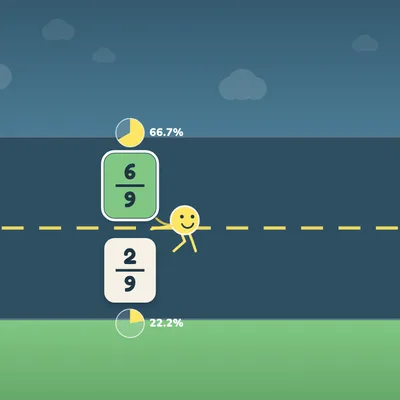
Simple challenge: Two fractions come toward you on two paths. Choose the path with the bigger fraction. Values never exceed 1. After every choice, both fractions unfold into circles and percentages.
After each answer you're back in the middle, so every choice is a real choice. If you don't choose, the game waits.
What you don't see: An adaptive system that watches more than right and wrong – streaks, patterns and how quickly the student recovers. When frustration threatens, the fractions get friendlier and the pace slows. When flow emerges, the system protects it. The philosophy draws on flow theory (Csikszentmihalyi) and the Zone of Proximal Development (Vygotsky).
The goal: Students don't just master fractions. They discover that mathematics can bring genuine joy rather than defeat.
Pro-tip: After some play, ask the student to explain how it feels when a fraction is bigger.
1234 1234
Controls: Keys 1–4 to choose a path, then ←→ to steer. On a touch screen, tap a path and swipe.
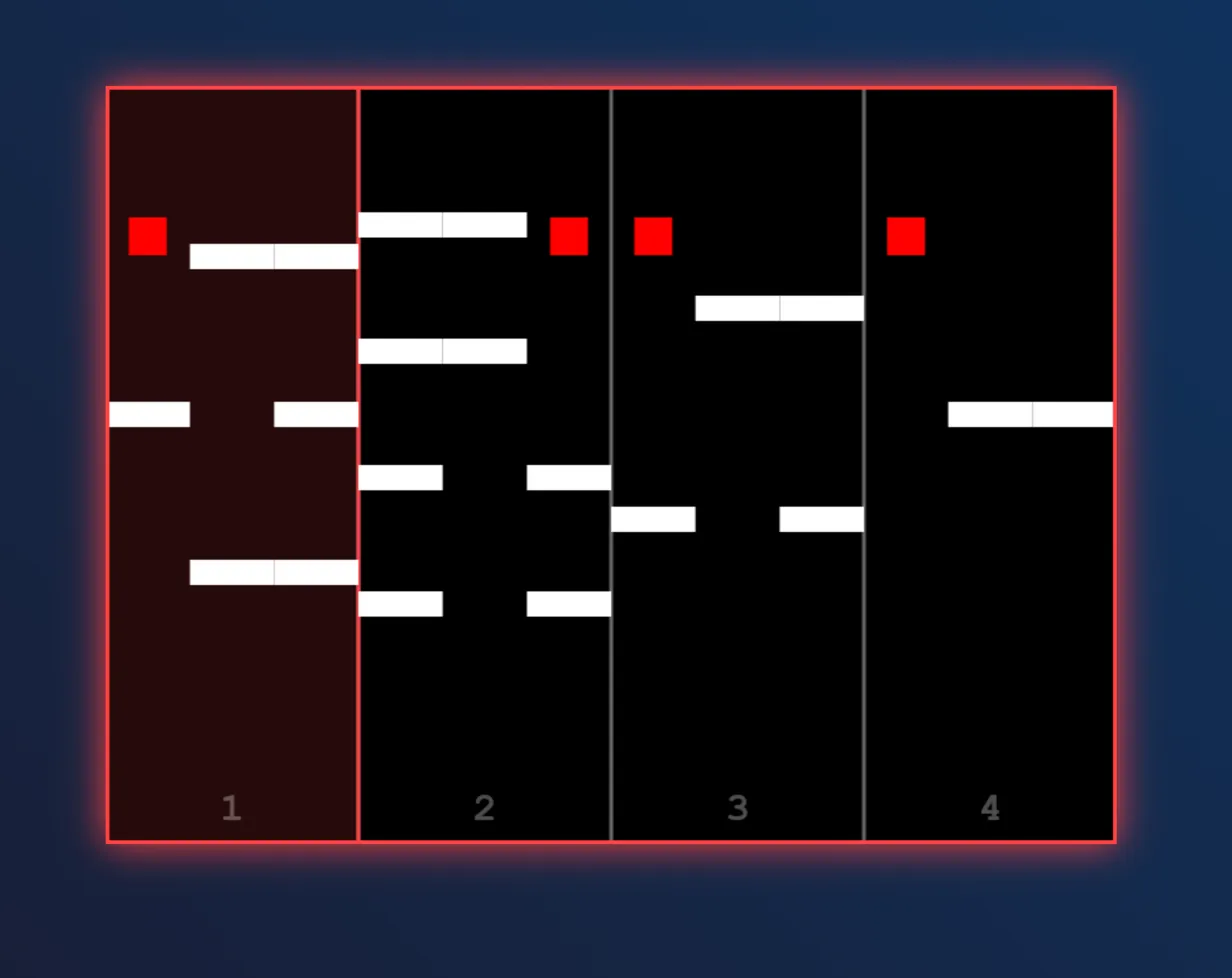
The final game is different. It doesn't represent an operation but engages with math in other ways. Four squares move up through four paths with 1–4 obstacles each. Choose a path, steer through the gaps.
Scoring: 100% requires all four squares reaching the top. A path with more obstacles counts for more. After four levels, the overall score is the four level scores added together and divided by four.
Think fast. Or maybe better, don't think at all. The game reaches nearly impossible speeds toward the end.
Pro-tip: I believe a 100% total score is humanly impossible, but I hope to be proven wrong someday.
I hope many students and teachers find value in 1234math. It's a labour of love based on my teaching experience and my master's degree in philosophy of education.
Math shouldn't be connected with feelings of inferiority and frustration. My ambition: that 1234math gives students confidence in their mathematical abilities – and maybe even sparks joy for the wonderful world of mathematics.
Steffen Dalsgaard Hansen
P.S. If your students are ready to learn about coding, check out Wobcode.com – an AI-powered vibe coding playground for kids.